
Reviewed: 28 July 2026
As a Vietnam team grows, monthly payroll becomes a chain of attendance cut-offs, overtime and allowance reviews, compulsory-insurance changes, personal income tax (PIT), payslips, payment and employee queries. The process may appear stable while one experienced employee handles it, but legal changes, absence, resignation or a late input can expose how much knowledge is held by one person.
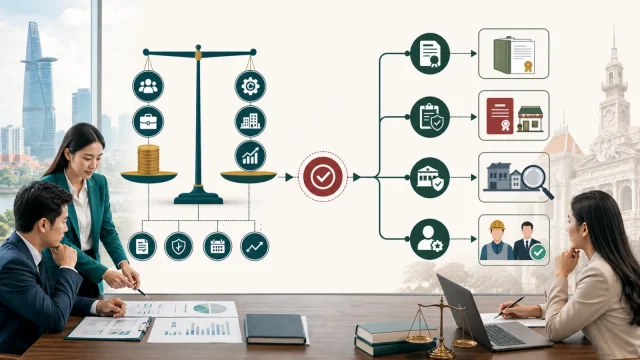
The business case for outsourcing payroll and social insurance is not simply labour savings. It is the opportunity to combine specialist knowledge, continuity, independent review and an auditable monthly process. The employer still keeps its decisions, approvals and legal responsibility.
The decision test: can another person reproduce the cycle?
A successful payroll this month does not prove that the process is controlled. Ask whether a qualified replacement can identify the source data, calculation rules, approved exceptions, statutory status and open issues, then produce the same result next month. If the answer depends on personal memory, private spreadsheets or an individual relationship with an authority, continuity risk is already present.
In-house payroll remains a valid model when the company has documented rules, current expertise, backup staff and independent review. Outsourcing becomes attractive when those capabilities are expensive to build or difficult to sustain locally.
Five reasons to outsource Vietnam payroll
1. Translate regulatory change into operations
Vietnam’s payroll environment spans labour, social insurance, PIT, employment administration and personal data. In 2025–2026, the new Social Insurance Law, regional minimum wages, Personal Data Protection Law and PIT rules all required operational review. A specialist provider should explain not only the legal update but which population, payroll field, effective date, calculation and report must change.
2. Strengthen accuracy and deadlines
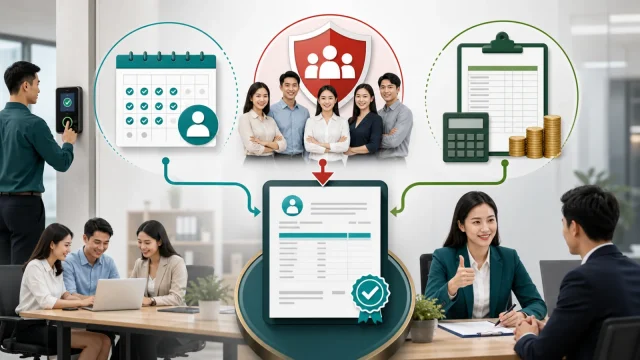
Payroll combines data from managers, HR, timekeeping, finance and employees. A structured service creates an input checklist, cut-off, validation, first calculation, query log, independent review, company approval and final delivery. Previous-month variance reports reveal errors that a simple net-pay spot check can miss.
3. Reduce key-person dependency
A provider with a named preparer, reviewer, backup and escalation owner can continue processing when one person is unavailable. This benefit exists only if the provider’s own workflow is documented; a single outsourced contact creates the same risk in another organisation.
4. Separate calculation, approval and payment
Payroll includes sensitive changes to salary and bank information. Outsourcing can separate the calculation team from the client approver and bank authority. Focus the approval on headcount, total employer cost, large movements, joiners, leavers, manual overrides and bank changes.
5. Formalise protection of employee data
Payroll contains identity, income, bank, dependant, insurance and tax data. Vietnam’s Personal Data Protection Law has applied since 1 January 2026. A service transition is an opportunity to define purpose, role-based access, secure transfer, logs, retention, deletion, incident response, subcontractors and data return. Outsourcing is not automatically safer; the controls must be verified.
In-house and outsourced payroll compared
| Factor | In-house | Outsourced |
|---|---|---|
| Company knowledge | Close to operations and employee context | Requires disciplined transfer of company-specific rules |
| Regulatory upkeep | Company recruits, trains and updates specialists | Can use a broader specialist team and change process |
| Continuity | Needs internal backup and succession | Can provide backup if staffing is genuinely redundant |
| Control separation | Can be difficult in a very small team | Calculation and company approval are naturally separated |
| Data boundary | Can remain within the company environment | Provider and subcontractor access must be governed |
| Cost | People, recruitment, training, systems and management review | Implementation, monthly, volume and exception charges |
What can be outsourced and what stays with the employer?
| Process | Provider can support | Company retains |
|---|---|---|
| Attendance | Format validation, missing data and exception report | Approval of actual work, overtime and leave |
| Payroll | Gross-to-net calculation, variance report, payslips and bank file | Compensation decisions, final approval and payment authority |
| Insurance | Working files for enrolment, changes, termination and contributions | Accurate employee status and employer accountability |
| PIT | Withholding and finalisation working data within scope | Residency, dependant and external-income information; approval |
| Employee queries | Explain calculations and route documented issues | Employment decisions and sensitive case resolution |
When outsourcing usually creates value
- One person owns payroll and there is no tested backup.
- Headcount or operating locations are growing faster than the HR team.
- Shifts, overtime, foreign workers or benefits create complex exceptions.
- Vietnamese operations and overseas management lose time translating payroll issues.
- Headquarters needs a consistent labour-cost and variance report.
- The company needs to redesign a process before replacing a legacy spreadsheet or system.
Outsourcing will not fix unapproved attendance, undocumented pay rules or an absent company owner. Resolve governance and input quality as part of implementation.
Build a total-cost comparison
For in-house payroll, include salary, recruitment, training, system licences, regulatory research, management review, leave cover, turnover and correction work. For outsourcing, include discovery, data cleanup, parallel runs, monthly base and employee fees, off-cycle or retroactive calculations, annual PIT, insurance cases, technology, VAT and exit support.
Also assign a value to risk: delayed payment, employee relations, duplicated contributions, data exposure and management time. A provider is not automatically lower-cost, but may produce a more predictable control environment.
Eight vendor-selection questions
- Exactly which payroll, insurance, PIT, attendance and employee-query tasks are included?
- Who monitors changes and how are effective dates applied to live payroll?
- Are preparer, reviewer, backup and escalation roles named?
- What are the source-data cut-off, first calculation, query and approval dates?
- How are access, encryption, retention, deletion, subcontractors and incidents controlled?
- Does the monthly pack show variances, manual overrides and unresolved items?
- Can the provider support Vietnamese operations and English or Japanese reporting?
- At exit, will it return data, logic, history and open-case status in an usable format?
A safe transition plan
- Diagnose: inventory pay items, formulas, attendance, populations, deadlines and owners.
- Design: approve a responsibility matrix, calendar, deliverables and escalation.
- Clean data: reconcile employee, leave, insurance, tax and recent payroll records.
- Parallel run: calculate the same period in both processes and explain material differences.
- Go live: retain company approval and bank controls; log every post-cut-off change.
- Review: monitor on-time delivery, adjustments, open issues and employee queries.
Frequently asked questions
Does outsourcing remove the need for company review?
No. The provider prepares and reviews within scope; the employer approves source decisions, final payroll, payment and statutory positions.
Is outsourcing worthwhile for a small team?
It can be when the process is complex, the sole owner has no backup or overseas reporting is important. Compare risk and management time as well as cost per employee.
Should all HR work be outsourced at once?
No. A phased approach can start with payroll and insurance working data, then add attendance validation or employee administration after the core cycle is stable.
Official references
- Social Insurance Law No. 41/2024/QH15
- Decree 158/2025/NĐ-CP on compulsory social insurance
- Personal Data Protection Law No. 91/2025/QH15
- 2026 PIT family deductions, Government policy portal